 EAGLE CORP
Fast FPGA drafting for H200 serving.
The talon is a box of eight AMD V80 FPGA cards that does the drafting half of EAGLE speculative decoding for H200 GPU servers. The H200 keeps the target model and only verifies; the talon proposes the token trees. Same output as the GPU alone, sooner.
measured talon2 server, 2026-11-19: humaneval 80 prompts × 256 new tokens, greedy; accept length 6.91 vs 6.90 (Llama) and 10.42 vs 10.46 (Qwen), so the speed-up comes from faster drafting, not from accepting more tokens per step. All 80 replies are identical to the reference, three rounds each. Everything marked [P] below is projected.
On silicon today: one user gets ×1.44 on Llama and ×1.12 on Qwen.
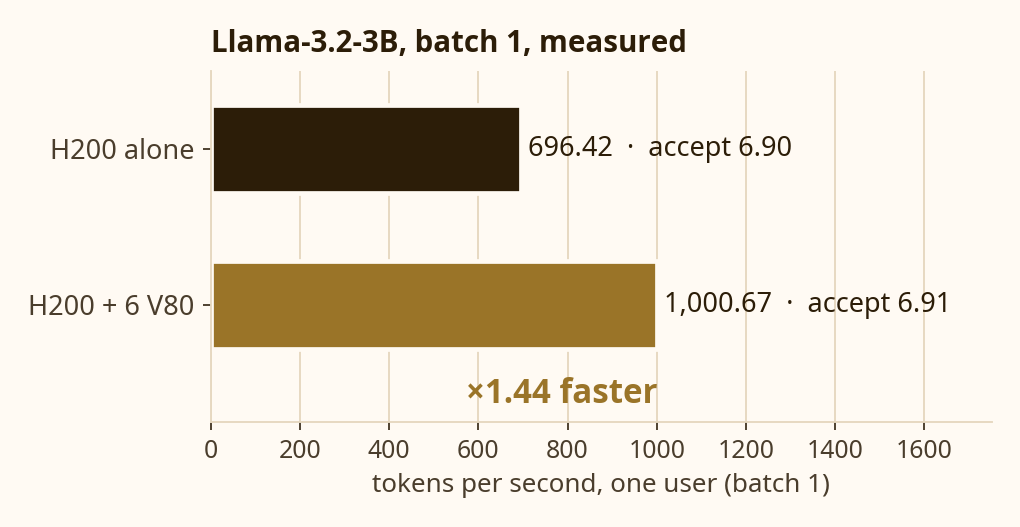
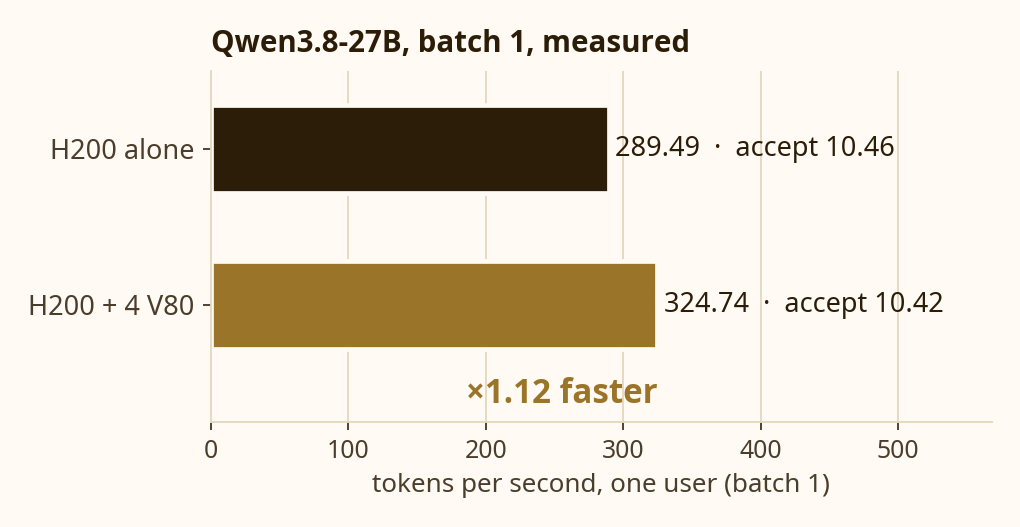
Batch 1 is what one user feels: tokens per second on their own reply. The Llama result reproduced on three separate power-ups of the server (1,000.67, 996.00 and 998.68 tok/s).
measured talon2, 2026-11-19, humaneval 80 × 256, greedy, depth-11 width-2 tree (Llama) and depth-15 width-2 tree (Qwen) on the cards; H200 alone = SGLang EAGLE with the GPU drafting, same target, same drafter weights.
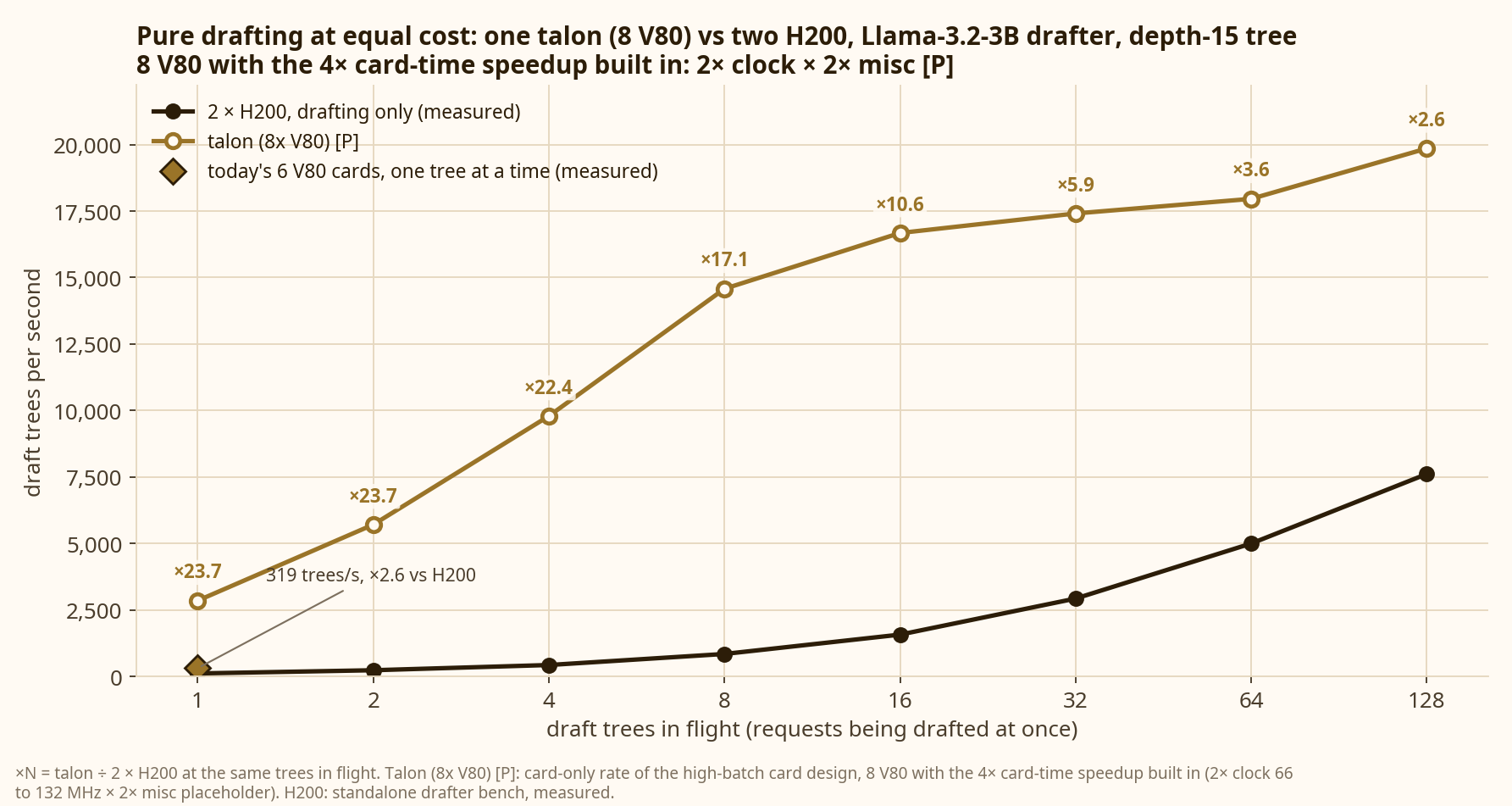
Drafting is where the talon is strongest: ×23.7 the drafting rate of two H200s at small batch.
Measured today
Today's six cards draft a full depth-15 tree in 3.13 ms: 319 trees/s, against 120.57 for an H200 drafting alone (×2.6). Today's cards draft one tree at a time, so the H200 overtakes them from about three trees in flight.
The talon design [P]
The talon drafts many trees at once (two 4-card sets taking turns) with the 4× card-time speedup built in. It stays ahead of two H200s at every batch from 1 to 128: ×23.7 at 1 tree, ×17.1 at 8, ×2.6 at 128.
Equal cost: one talon box vs two H200
Taking as a premise that one talon box costs the same as two H200s, these ratios are drafting throughput per unit cost. No prices are assumed.
| draft trees in flight | 1 | 2 | 4 | 8 | 16 | 32 | 64 | 128 |
|---|---|---|---|---|---|---|---|---|
| talon ÷ 2 H200, drafting throughput per unit cost [P] | ×23.7 | ×23.7 | ×22.4 | ×17.1 | ×10.6 | ×5.9 | ×3.6 | ×2.6 |
| same, against the H200's in-engine draft time | ×14.0 | ×14.0 | ×12.5 | ×9.8 | ×6.3 | ×3.9 | ×2.8 | ×2.5 |
talon (8x V80): 8 V80 with the 4× card-time speedup built in: 2× clock (66→132 MHz, roadmap) × 2× misc (placeholder) [P]. H200 line = standalone drafter bench (same tree, same context of 566 tokens, no target loaded). Inside SGLang the H200 drafts one tree faster (4.91 ms), so the second row is the conservative comparison. Drafted tokens per tree = 29.
While one GPU verifies, the talon drafts for the next: the cards are busy only 32% of each step.
Measured on one server: a Llama step takes 6.9 ms and the cards are busy for 2.2 ms of it (31.6%), so one card set has room for about 3 servers. On Qwen3.8-27B the GPU verifies longer and the cards are busy 18.7% of the step, room for about 5 servers per 4-card set.
The bigger the target, the more GPUs per talon
A longer verify on the GPU means a smaller busy share on the cards. A talon (8x V80, 4× card-time speedup built in) keeps 33 Qwen H200s drafted at batch 1 and 38 at batch 8 [P].
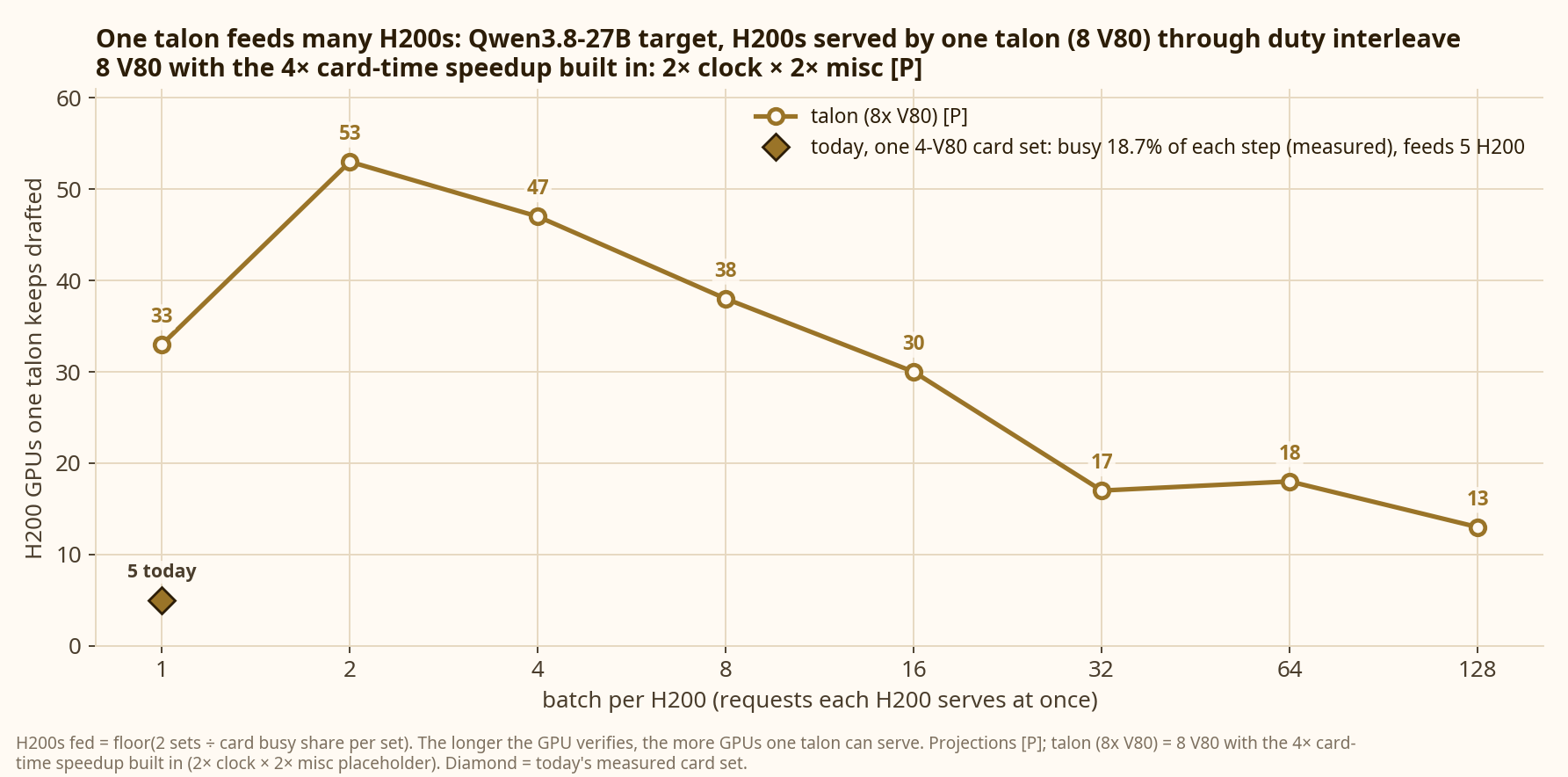
measured busy share = card time per step ÷ step time, from on-card counters and the serving rate (Llama record set, batch 1, 3 rounds; Qwen set, batch 1). Servers per set = floor(1 ÷ busy share); per talon (two sets) = floor(2 ÷ busy share per set) [P]. Interleaving three servers on one card set is a projection; one server per set is what has run.
Add one talon to an 8×H200 node: ×1.82 at batch 1, up to ×3.26 at batch 64 [P].
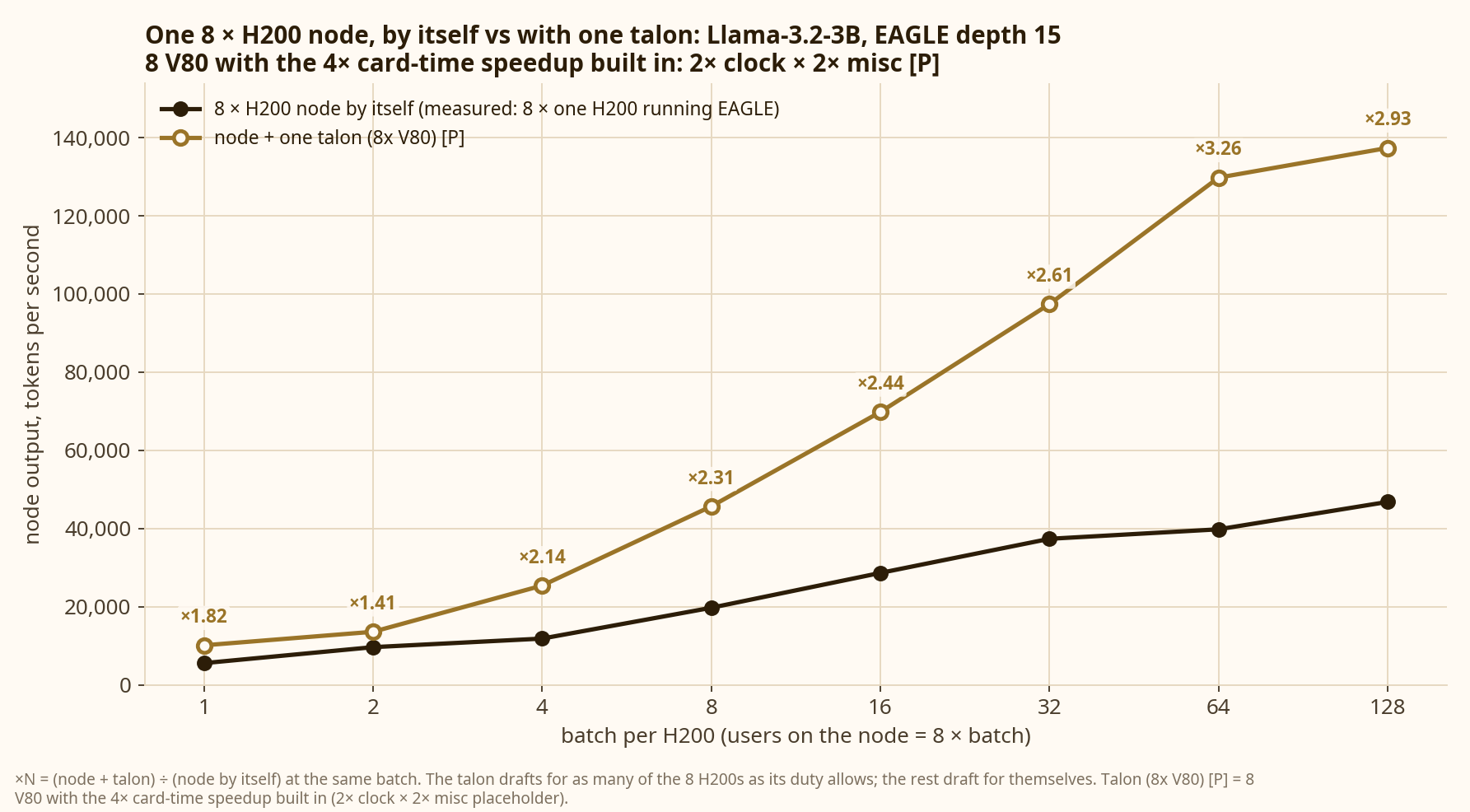
| batch per H200 | 1 | 2 | 4 | 8 | 16 | 32 | 64 | 128 |
|---|---|---|---|---|---|---|---|---|
| users on the node | 8 | 16 | 32 | 64 | 128 | 256 | 512 | 1,024 |
| Llama-3.2-3B: node + talon ÷ node [P] | ×1.82 | ×1.41 | ×2.14 | ×2.31 | ×2.44 | ×2.61 | ×3.26 | ×2.93 |
| Qwen3.8-27B: node + talon ÷ node [P] | ×1.44 | ×1.71 | ×1.72 | ×1.92 | ×1.44 | ×1.59 | ×1.90 | ×2.04 |
The H200s the talon feeds stop drafting and only verify; the others keep drafting for themselves. The Qwen node baseline above batch 1 comes from a verify-time model calibrated on measured H200 runs.
One talon + 6 H200 servers, Llama
| batch per H200 | 1 | 2 | 4 | 8 | 16 | 32 | 64 | 128 |
|---|---|---|---|---|---|---|---|---|
| 6 H200 by themselves, tok/s | 4,179 | 7,245 | 8,889 | 14,802 | 21,487 | 28,031 | 29,854 | 35,116 |
| the same 6 H200 + one talon, tok/s [P] | 7,599 | 10,194 | 19,063 | 34,260 | 52,365 | 73,063 | 97,330 | 125,658 |
| gain | ×1.82 | ×1.41 | ×2.14 | ×2.31 | ×2.44 | ×2.61 | ×3.26 | ×3.58 |
talon (8x V80): 8 V80 with the 4× card-time speedup built in: 2× clock (66→132 MHz, roadmap) × 2× misc (placeholder) [P]. Node by itself = 8 × the measured single-H200 EAGLE rate at that batch.